Better Monetization in Live Sport Without Cost and Complexity, and Without Losing Fans

The Tradeoff: More Ad Revenue OR a Good Viewing Experience – Conventional Wisdom Says You Can’t Have Both
Premium streaming platforms are trapped in an operational dilemma. On one side, viewers have ad fatigue: burnt out by intrusive, full-screen mid-roll ads that interrupt the experience of live sports and entertainment. On the other side, platforms are seeking new ad revenue streams to offset skyrocketing content rights fees and infrastructure costs.
Conventional wisdom says that you can’t increase monetization through advertising without sacrificing user experience. But as I will explain, that wisdom no longer holds true. Non-disruptive, interactive ad experiences offer streaming services a way to significantly expand high-value ad inventory without pushing subscribers toward the exit:
- Animated Picture-in-Picture (PiP) Ads: The main broadcast smoothly scales down into a smaller window during breaks, allowing an ad or a sponsor's motion graphics to fill the surounding canvas while keeping the action live on screen
- Side-by-Side Ads: Also as an animation, the broadcast shrinks to one half of the screen to make room for an ad in the other half, e.g. when there is an injury delay.
- Live Data-Driven Graphic Overlays: Real-time contextual graphics, stats that can be sponsored, and betting odds integrated seamlessly into the play-by-play.
- Contextual E-Commerce Tags: Interactive or QR-coded overlays enabling viewers to instantly purchase merchandise or featured products without navigating away from the stream.
These dynamic formats unlock valuable new revenue opportunities – all while keeping eyes firmly glued to the screen.
Operational Limitations
If these non-disruptive formats are so clearly effective, why aren't all OTT platforms and broadcasters running them on every stream? Historically, attempting to deliver these "advanced" visual experiences has meant assembling an operational headache.
To achieve non-disruptive ads and live overlays, engineering teams have had to stitch together a fragmented legacy tech stack:
- Dedicated, specialized graphics rendering engines for on-screen overlays.
- Something listening to a data fee to determine when to insert ads or show and hide graphics
- External Dynamic Ad Insertion (DAI) ad stitchers, possibly using a video mixer for picture-in-picture and side-by-side advertising
- Cloud encoders and packagers.
- Custom glue code and complex signal routing across all of these.
Replacing a traditional broadcast production workflow to yield these same final pixels requires a convoluted, fragile setup.
The Consequences
When you force disparate vendor tools to interact in real time during a live broadcast, the system can break under its own weight:
- Increased Complexity & Maintenance Costs: The resulting stack requires dedicated expertise and engineering bandwidth to maintain and monitor, turning basic broadcast operations into an ongoing fire-fighting exercise.
- Latency & Broken Sync: Synchronizing graphics, audio, and ad triggers across disparate processes is hard. A scorebug can update before the goal was scored, an ad may shown while the referee has yet to stop the game.
- Ad-Blocker Vulnerability & Dropouts: While it’s harder to block server-inserted ads than client-inserted ones, older server-side ad systems may leave visible ad tags in the video stream's code that modern ad blockers still spot. This can lead to blocked ads, black screens, and even stream crashes.
- Escalating Cloud OpEx: Running three, four or even five independent cloud processing systems in parallel consumes unnecessary cloud computing compute resources, generating cloud bills that swallow your ad margins.
No matter how skilled your engineering team is, the architecture itself often makes it difficult to reliably optimize the viewer experience or roll out new ad formats at scale. It may work for a single marquee event, but it's hard to scale across every game in every competition, for a full season.
Tiledmedia Fabric: One Pipeline instead of five systems
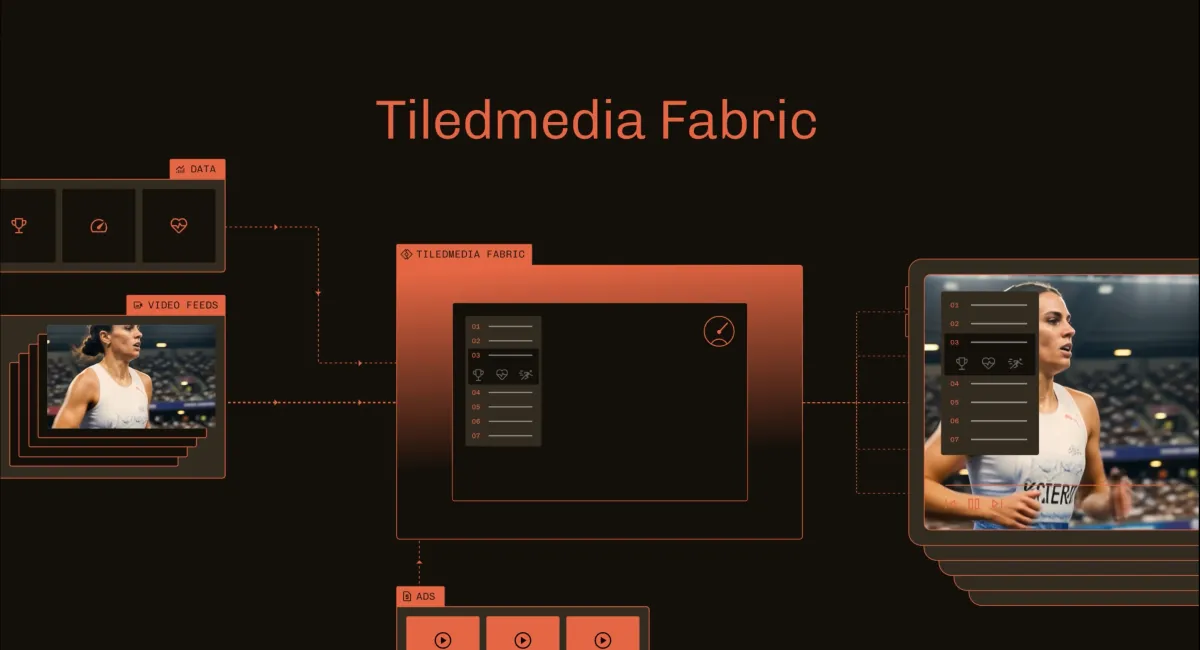
To solve this systemic challenge, and working with our customers, we introduced Tiledmedia Fabric: a single, cloud-hosted, data-driven video processing platform built to replace traditionally fragmented production, graphics, and transcoding chains.
Fabric fundamentally alters the streamed content delivery paradigm. Instead of juggling multiple point solutions, Fabric operates as an integrated orchestrator. It weaves raw video feeds, dynamic ad media, graphics, animations, and real-time metadata into fully produced, CDN-ready streams as an integral part of the transcoding process. It removes the need for complicated, error-prone cross-system coordination.
Frame-Accurate, Data-Driven Pixel Control
Because visual manipulation happens inside the media pipeline triggered by real-time data inputs, Fabric gives operators frame-accurate pixel control to provide:
- Live Game-break Ads: Automatically shrinks the main broadcast window into a smooth PiP arrangement to make room for an ad, e.g. when a data feed signals commercial timeout, and fuses the program feed with the ad into a single video
- Data-driven Scoreboards & Graphics: Uses live metadata to drive animated graphic overlays burned into the video feed, updating instantly as scores, timers, and stadium clocks change, and in sync with the events on the pitch.
- Targeted Ad Injections: Instantly renders contextually relevant graphics (sponsor messages, stills, …) directly into the stream without requiring downstream re-encoding.
Everything is data-driven and automated, but operators can still trigger events manually or through an API when the incoming data didn't predict an event. Adding a new format, e.g. a new sport, is a matter of designing the graphics and defining the logic. No need to integrate yet another vendor.
Faster, Bankable Innovation
By moving processing to a single data-driven pipeline, Fabric unlocks monetizable innovation that was previously too risky or too complex to deploy.
Creative Ad Formats That Drive High Yield
Fabric allows streaming providers to think beyond standard 15-second pre-rolls:
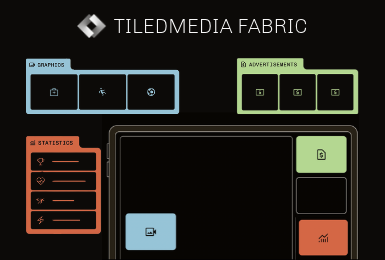
- The "L-Bar" Squeeze: The main program seamlessly scales back to allow for an "L-shaped” ad frame, displaying animated sponsor graphics, live betting lines, or video animations around the main video.
- Side-by-side Advertising: as above, but with the main program moving to one half of the screen in an graceful animation, making room for an ad to play in the other half.
- Data-Triggered Performance Ads: Sponsored high-impact moments, such as an instant branded animation appearing whenever a goal is scored, complete with an interactive e-commerce QR code.
Extreme Throughput
While Fabric excels at mainstream OTT and broadcaster distribution, its extreme throughput capabilities are built for the most demanding media workloads on the planet.
Fabric was recently deployed to power Meta’s new Immersive Sports service on it's Quest headsets and the upcoming Meta VR Glasses. Delivering smooth 8K video at 60 fps alongside spatial audio and a server-side inserted virtual Jumbotron requires clever processing. Fabric's capabilities are used to ingest 8K video feeds, process metadata, and fuse dynamic score bugs and PiPs into the main video. Fabric further encodes and packages 8K ABR ladders in real time and outputs these as CDN-ready streams, proving that it easily handles massive multi-8K data demands where traditional workflows choke.
Key Business Benefits for OTT & Broadcasters
For broadcasters and OTT operators, replacing a legacy stack with Tiledmedia Fabric yields immediate commercial and operational advantages:
1. Maximized Monetization with Superior Customer Experience
By unlocking high-value, non-intrusive ad formats, you open premium ad inventory that commands higher CPMs while reducing viewer churn and ad fatigue. Recent live sports benchmark data demonstrates the tangible business lift of these formats:
- Higher Brand Engagement: When ads run directly alongside live play rather than interrupting it, viewers are 27% more likely to engage with the featured brands (Prime Video NASCAR, EDO via Amazon Ads, 2025).
- Extended Watch Time & In-Play Betting: Incorporating rich data overlays increases viewer time on stream by 35% and drives a 22% rise in in-play betting activity (Sportradar on ATP tennis, vendor-reported, 2025).
2. Tech Stack Consolidation & Substantial Cost Reduction
Fabric collapses up to as many as five separate vendor licenses into one: a standalone graphics engine, an ad-stitcher, a video mixers and an encoding/packaging platform. To quantify the financial impact, consider the total cost of ownership (TCO) across typical streaming deployment models using list prices from known vendors:
- 24/7 Channel Delivery over a 3-Year Lifecycle: Consolidating with Fabric can provide an up to 70% operational cost reduction by replacing multiple licenses with a single license and reducing the cost of operating the pipeline.
- Events: In this scenario, Fabric will also reduce total technical and operational costs, and perhaps by as much as 50%, but the real value is found in the enhanced capabilities, leading to nd increased engagement and improved monetization.

Next-Level Capabilities with the Tiledmedia Player
This post focuses on how Tiledmedia Fabric simplifies video processing delivery of streams that look the same to all viewers. That only scratches the surface of Fabric's capabilities—it shines even more when pairing it with the Tiledmedia Player. By combining our production engine with our intelligent player, streaming platforms unlock advanced, interactive, personalized, “lean-forward” experiences. These include:
- Multiview Ads: Tiledmedia Player’s multi-stream capabilities allow a much smoother user experience than with traditional stream/player switching. No more gaps, black screens, or stalls when switching between ads and content. Additionally, Tiledmedia Player allows you to do squeeze-backs and overlays in the player. This combines full personalization, based on viewer-specific profile data and real-time behavior, with a much better, much less intrusive, user experience.
- Client-side, Unlimited-Feed Multiview: Allow viewers to seamlessly select, arrange, and switch between multi-camera feeds or multi-game views on a single screen in real time.
- Dynamic, Interactive Data Overlays: Locally animated graphics that stay in sync with the video. Clickable on-screen stats, live betting odds, on a layout that can be controlled by the viewer.
While further exploring these advanced client-side capabilities is beyond this post's scope, they offer powerful tools to drive premium subscription tier upgrades, command higher-yield targeted ad inventory, and further reduce subscriber churn.
Get in Touch!
Delivering innovative, highly engaging advertising shouldn’t be prohibitively expensive or operationally painful. By unifying video processing with real-time data and dynamic advertising in a single platform, Tiledmedia Fabric gives media companies the freedom to innovate, without breaking the bank or pushing operations teams to the limit.
Ready to see how Tiledmedia Fabric can help you maximize revenue while streamlining your infrastructure? Book a briefing with our experts today!

Recent updates and events


Transform your streaming experience
Schedule a live demo with our team to see how our products can slash your bandwidth costs and maximize your viewer engagement.